
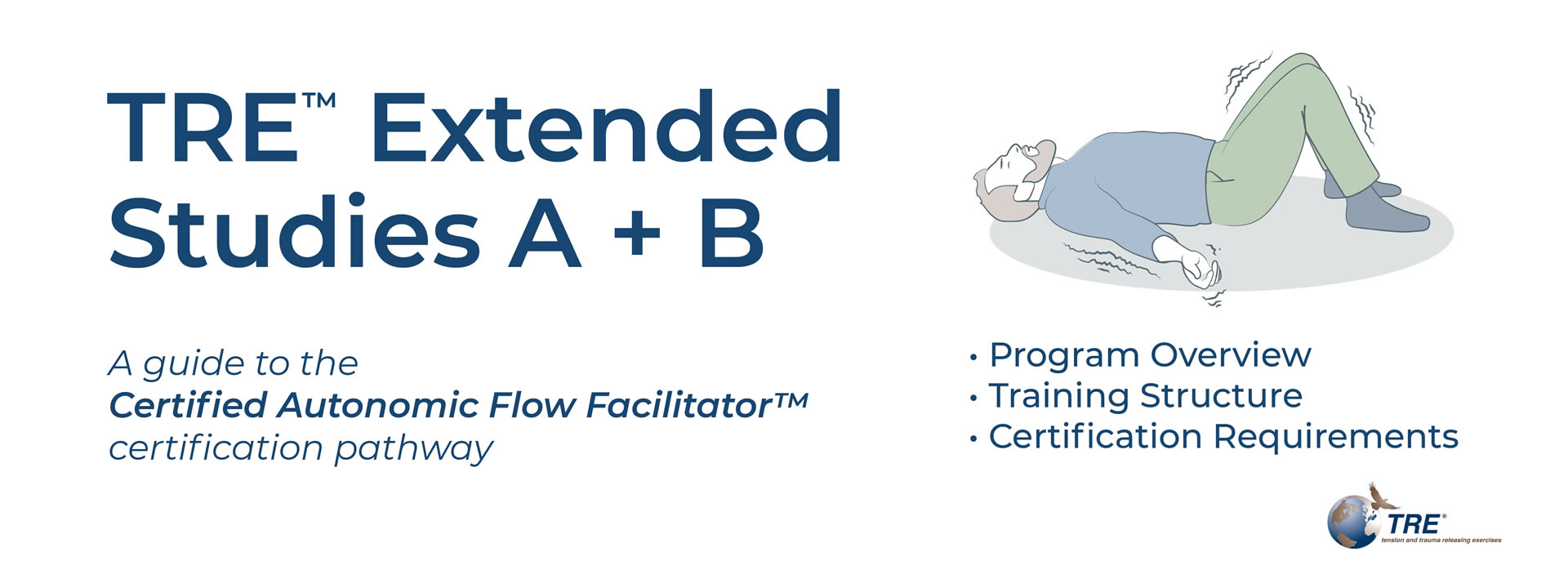
TRE™ Extended Studies A+B
Program Overview
Training Structure and Certification Requirements
A practical guide to the
Autonomic Flow Facilitator Certification™ pathway
Start Date: Tuesday 5th of January at 2 pm CET.
TRE Extended Studies A and B are designed for Certified TRE Providers who want to deepen their personal TRE practice, expand their facilitation repertoire, and develop greater capacity to follow tremoring, autonomous movement, and whole-body release over time.
The training builds on the foundation of the TRE Provider Certification Training and combines recorded courses, live integration sessions, mentoring, personal practice, applied provider work, individual guidance, video-based learning, and reflective professional development.
Completion of TRE Extended Studies A and B, together with the associated practice and certification requirements, leads to the title:
Certified Autonomic Flow Facilitator™
How the training is organised
TRE Extended Studies A and B each consist of approximately six months of scheduled coursework as well as a set of work requirements that needs to be completed for certification.
Each part includes:
- three recorded courses
- six live integration sessions of two hours
- one live six-session mentoring and practice group series
A and B can therefore be completed as coursework within approximately one year.
Alongside and after the scheduled coursework, participants complete the personal practice, applied provider work, individual guidance, reflective documentation, video requirements, and final certification review at a pace appropriate to their professional opportunities and life circumstances. You do not need to complete every work requirement from A before beginning B.
Final certification normally requires that at least two years have passed since completion of the foundational TRE Provider Certification Training. Participants may begin TRE Extended Studies before reaching the two-year point.
TRE Extended Studies A:
Positions, Transitions and Following Autonomic Movement Flows
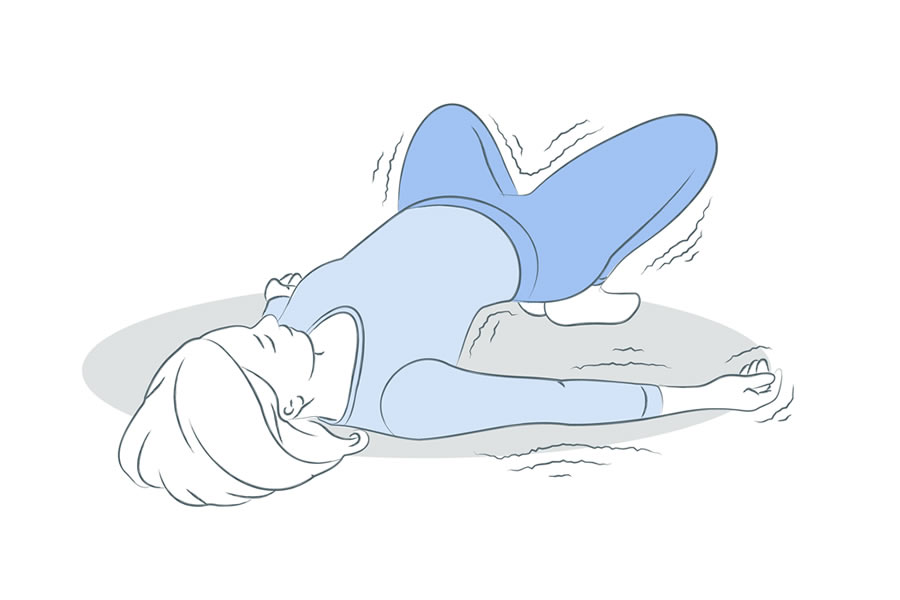
Different positions provide different possibilities for movement. A position that supports one movement may restrict another, and the body may indicate or attempt movements that are difficult to complete in the position it is currently in. Some of the clearest examples are flexion and extension movements, as well as rolling movements, where the body is often also transitioning from one position to another and moving through a more continuous movement flow.
Developing a broader repertoire of positions and transitions therefore helps the provider recognise how positions can facilitate or limit the unfolding tremor and movement process. It also supports the ability to follow the body more fluently, and become more responsive to the individual person and the body’s own autonomous organisation. This is the primary domain of TRE Extended Studies A.
The course content is provided in three recorded courses from the TRE In Depth course series, followed by 2 live integration sessions per course, and a 6-session mentoring group series.
You can read more about the recorded courses and the live mentoring series on the following links.
Tremoring in Sitting: Read more here
Tremoring in Standing: Read more here
Tremoring in Side Lying: Read more here
Six live integration sessions of two hours
Mentoring group series: Read more here
Dates for the Integration Groups
Tuesdays from 2 pm to 4 pm CET/CEST Oslo/Paris
Topic: Tremoring in Side-lying
- 5th of January, 2027
- 19th of January, 2027
Topic: Tremoring in Sitting
- 2nd of March, 2027
- 23nd of March, 2027
Topic: Tremoring in Standing
- 4th of may, 2027
- 18th of May, 2027
Dates for the TRE™ Mentoring and Practice Group
2027 Dates
We meet online on Zoom on Tuesdays from 2 pm to 4 pm CET/CEST (Oslo, Paris), on these dates:
- 2nd of February
- 16th of February
- 6th of April
- 20th of April
- 1st of June
- 15th of June

TRE Extended Studies B:
Whole-Body Tremoring, Embodied Integration and Deeper Release
The basic exercises and positions also tend to draw attention to and activate certain parts of the body more than others. Tremors typically begin, with individual variation, in the thighs and pelvis and may then gradually spread to other parts of the body. For some people this happens relatively quickly, while for others it develops much later, only to a limited degree, or not at all.
There are many individual reasons for this, but one important factor is that the exercises and positions themselves facilitate tremoring and release in some areas of the body much more directly than in others. Areas that may remain less involved, even in people whose tremors otherwise spread easily through the body, include the shoulders, arms, hands and fingers, the head and different areas of the face, the neck and throat, as well as the lower legs, feet, and toes.
In TRE Extended Studies B, you learn how to facilitate tremoring and other forms of release more directly in these areas of the body.
The course content is provided in three recorded courses from the TRE In Depth course series, followed by 2 live integration sessions per course, and a 6 session mentoring group series.
The course content is provided through three TRE In-Depth courses, with two live integration sessions connected to each course, together with a six-session mentoring and practice group series. Two of the courses are provided as recordings, and one will be offered as a live course, and then later as a recording.
TRE and the Upper Body: Read more here
Tremoring Including the Hands and Feet: Read more here
TRE and the Head, Face and Related Areas
This course is not recorded yet and will be offered as a live course.Six live integration sessions of two hours
Mentoring group series: Read more here
Certification requirements
Certification requirements
To become a Certified TRE In-Depth Provider, participants complete TRE Extended Studies A and B together with the following practice and certification requirements:
- TRE Extended Studies A + B coursework
- 6 recorded courses, 3 in A and 3 in B.
- Each video in the courses are highly practical and all videos included a TRE session focused around the topic of the course.
- 2 live integration sessions of 2 hours per course, in total 12 sessions.
- 2 mentoring and practice group series, each with 6 sessions of 2 hours.
- Personal TRE practice
- 24 documented personal practice sessions connected to the course material
- concise practice logs and reflections focused on your personal experience
- Applied provider work
- Group pathway for providers working with groups:
- Teach 2 TRE group series of at least 5 sessions and 1 group series of 10 sessions
- Individual pathway for providers working only with individuals:
- Facilitate 4 individual TRE processes of at least 5 sessions and 1 individual process of 10 sessions
- Write logs and reflection summary from your teaching experience
- An adapted combination can be agreed for providers working with both individuals and groups
- Individual guidance
- 4 individual sessions of 90 minutes with TRE trainer Hans Holter Solhjell
- Video-based learning
- Record 5 facilitation sessions
- Review videos and write a reflection document and summary
- Select video excerpts to be discussed during individual guidance
- Final certification review
- 1 individual 120 minute session including video review of self selected video excerpts, reflection documents and summary of learning experience.
Personal practice
Personal practice is an important part of the pathway. Participants use the course material in their own TRE practice and keep concise notes and reflections to support learning, mentoring, and individual guidance.
Applied provider work
Participants apply the material through ongoing work with individuals, groups, or a combination of both, and keep concise logs and reflections from these processes. Five facilitation sessions are also recorded for self-review, with selected excerpts used for feedback during individual guidance.
Existing or paying clients may be included when this is appropriate to the provider’s professional scope, alligned with clients needs and interests, and when confidentiality and informed consent are properly addressed.
Individual guidance, video review and feedback
Participants complete four individual 90-minute sessions during the certification pathway.
These sessions provide space for questions, review of applied work, log summaries and videos, feedback and personal TRE practice
Final certification review
The pathway concludes with an individual 120-minute final review.
The review brings together the participant’s coursework, personal practice, applied provider work, reflective documentation, video material, and development of the required competencies.
The review is developmental and competency based rather than a conventional academic examination.
Program Fees
TRE Extended Studies A
- Three recorded courses with six live two hour integration sessions:
US$1,047 - One mentoring and practice group series:
US$399
TRE Extended Studies A coursework total: US$1,446
TRE Extended Studies B
- Three recorded courses with six live integration sessions:
US$1,047 - One mentoring and practice group series:
US$399
TRE Extended Studies B coursework total: US$1,446
Participants who already own one or more recorded courses can receive an adjusted price for the relevant live training component.
Certification-related individual sessions and final review
The certification-related individual work is paid separately as it is completed:
- Individual guidance: US$225 per 90-minute session
Four required sessions: US$900 - Final 2 hour certification review: US$445
Total costs for the full certification program
Current standard total for A+B coursework and certification requirements: US$4,237
Payment Plans and Financial Accessibility
We want the training to remain accessible to committed participants from different countries and financial situations. Adapted payment schedules may be available by agreement.
A limited number of reduced-fee places may also be available for participants with significant financial challenges. Payment plans and reduced-fee places are considered individually.
If the full fee is not financially possible for you, please contact us before registering. Briefly describe your situation, your motivation for joining the training, and what kind of payment arrangement would make participation possible.
Payment options
All prices are listed in USD.
For international payments, we prefer Wise.com whenever possible, as it usually gives clear exchange rates and helps reduce international transfer and currency-conversion costs.
| Payment option | Use |
| Wise.com | Preferred for international payments |
| Worldline / card payment | Available for participants who prefer card payment |
|
Direct bank transfer
|
Available when suitable |
| I need another option |
You can indicate your preferred payment method in the registration form.
First-time Wise users may need to create an account and verify their identity, so we recommend setting this up before the payment deadline.
If none of these options are practical for you, please contact us before payment so we can find a suitable solution.
About Hans Holter Solhjell
TRE™ Global Certification Trainer
Trauma Release, Relational Resolution & Embodied Vitality
Creator of AFF™ , CAREp™ and the PLS Response Funnel Framework™
Hi and thank you for your interest in the TRE Extended Studies Program! My name is Hans Holter Solhjell. I am a TRE Global Certification Trainer, educator, and body-oriented trauma therapist based in Norway. I have practiced TRE since 2010 and have extensive experience with TRE Provider training, individual sessions, mentoring groups, longer-term TRE processes, combining TRE with other somatic, cognitive and relational work, and supporting continued professional development.
My professional background includes a master degree in pedagogy, certification in Somatic Experiencing, the Feldenkrais Method and the Sounder Sleep System, and 30 years of experience with embodied and mindful movement, stress regulation, communication, and conflict resolution. I am also the developer of AFF™ , CAREp™ and the PLS Response Funnel Framework™.
TRE Extended Studies and Autonomic Flow Facilitation™ has developed through many years of personal TRE practice, teaching, training and mentoring others, observation, experimentation, and work with providers and longer-term TRE processes.
I warmly welcome you to continue developing your personal TRE practice and facilitation skills through the program.

”I had been working with TRE for a couple years. I had done sessions with facilitators. I was stuck with the same type of tremors, same blocks and pain for almost a year.
After just one session with Hans, I had completely transformed. He is extremely experienced and creates a safe space for big releases. His expertise in trauma therapy and Somatic Experiencing helped me stay grounded and to be able to deal with painful memories during TRE releases.
If you need a next level TRE facilitator, look no further. He will get you on your journey to deeper releases.
Thanks again Hans. I will never forget how you helped me.”
What you will develop
A broader embodied TRE practice
You will gain personal experience with tremoring and movement in different positions and through more areas of the body. Repeated practice also helps you notice your own preferences, habitual movement patterns, areas that participate easily, areas that remain less involved, and how you respond when unfamiliar movement emerges.
More flexible facilitation
You will develop greater ability to recognise positional and directional impulses, support transitions, adjust positions and exercises, work with different levels of intensity, and respond to the individual person rather than relying mainly on a standard TRE sequence.
An important theme is learning when to provide guidance and when to allow the process to organise itself.
Facilitate development over series of sessions
The training also explores how TRE facilitation can evolve across a series of sessions, going deeper with the exercises and providing variation, rather than repeating essentially the same basic introductory format each time.
You will learn to create gradual progression while maintaining grounding, autonomy, choice, pacing, and responsiveness to the individual or group.
Recognising broader autonomic release
TRE Extended Studies A and B also introduce a broader perspective on autonomic release beyond tremoring alone. This can include changing patterns of breathing, contraction and expansion, vocalisation, emotional expression, pushing, reaching, turning, protective movements, coughing or retching-like responses, and other spontaneous bodily processes.
This is introductory within A+B. Broader forms of autonomic release are developed more fully in later TRE Extended Studies modules and the CAREp pathway.
Supporting the individual process
TRE Extended Studies A and B seek to expand the provider’s personal embodied experience and practical facilitation options. The purpose is not to replace the foundational TRE structure or to encourage more or larger tremors for their own sake. It is to develop greater sensitivity to what the body is attempting to do, to support deeper release when this is a felt need or interest, and to respond more flexibly to the individual process that is actually unfolding.
A key principle throughout TRE Extended Studies is the relationship between autonomic processes and personal autonomy. Autonomic refers to physiological processes such as tremoring and spontaneous movement that arise largely outside deliberate control. Personal autonomy refers to the participant’s ability to remain an active agent in the facilitation process—with choice, boundaries, self-direction, and authority over how their own experience is understood and interpreted.
Facilitation therefore involves both becoming more skilful at recognising and supporting autonomic movement and release, and doing so in a way that strengthens the participant’s autonomy and self-determination.
Broadening your TRE Practice
Develop a wider facilitation repertoire of positions and skills to support whole-body tremoring, autonomic movement flows and release
The seven basic TRE exercises and the commonly used back-lying tremoring position provide an important and accessible foundation for TRE practice. For many participants, this basic structure remains useful over a long period of time.
At the same time, there is a larger potential for embodiment, tremoring, deeper release, and integration within the basic exercises than is realised by many. Further, as tremoring and autonomic movement develop, the basic positions are not always the most supportive of the movements and forms of release the body is seeking to express.
TRE Extended Studies A and B are designed to address this by broadening both the positions in which tremoring and movement can be supported, and the areas of the body that can become more actively involved in the process. A focuses on positions, transitions, and following autonomic movement flows, while B focuses on facilitating tremoring and release in areas of the body that are typically more difficult to access, supporting embodied integration and deeper release.
Together, TRE Extended Studies A and B provide a structured path for developing a more flexible, responsive, and body-led TRE practice and facilitation approach. This forms the foundation of Autonomic Flow Facilitation™: observing, recognising, following, and supporting autonomic flows of movement, tremoring, and release, with attention to regulation and integration throughout the process.
FAQ
Who can join?
TRE Extended Studies A and B are designed primarily for Certified TRE Providers. TRE Provider trainees may also be able to join toward the end of their certification training.
Do I need to have been certified for two years before starting?
No. You can begin TRE Extended Studies before the two-year point, although at least two years should normally have passed before final certification as a TRE In-Depth Provider.
Do I need to complete A before starting B?
A is intended to precede B, but you do not need to have completed all A practice and certification requirements before beginning the B coursework.
Can I participate without completing the certification?
Yes. Individual modules can also be taken for continuing personal development, although participants working toward certification may receive priority when groups are full.
Can I complete the applied work with individuals only?
Yes. There are separate pathways for providers working mainly with individuals and those working with groups.
Can I use existing clients?
Yes, when this is appropriate to your professional scope and informed consent, confidentiality, anonymisation, and any video requirements are properly addressed.
What if I already own one of the recorded courses?
You will not need to repurchase the same recorded material. An adjusted fee and a discount code reducing the price will be provided for the live integration component.
