
Why The TRE™ Extended Studies Program
and Autonomic Flow Facilitation™
Has Been Developed
Hans Holter Solhjell
TRE™ Global Certification Trainer
TRE™ Extended Studies Lead Trainer
Program Developer and Educational Director

This article outlines four of the main reasons the program has been developed: following the body more closely and supporting greater autonomy, understanding different relationships to movement and body-led processes, developing TRE work over time, and recognising a broader range of autonomic movement and release beyond tremoring alone.
1. Greater capacity to follow the body, support autonomy, and develop a broader movement repertoire
A central purpose of the TRE Extended Studies Program is to help providers develop a greater capacity to follow the body: to observe what the body is actually doing and support greater personal autonomy in autonomic movement and release.
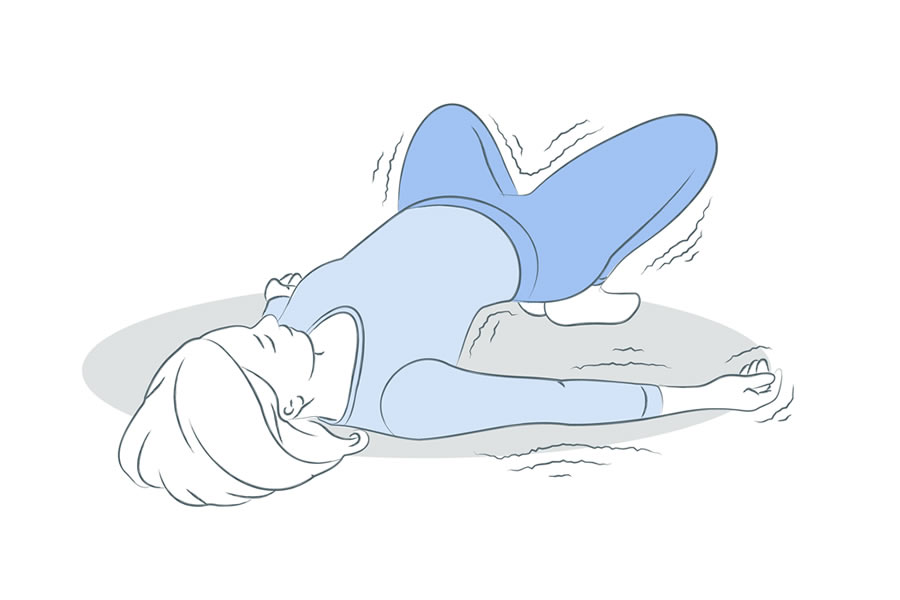
Tremoring while lying on the back is the standard format in the basic TRE template and provides an important foundation. However, the back-lying position also places clear physical restrictions on how the body can move.
Over many years of teaching training, mentoring, and supervising TRE Providers from a range of training programs, and from most parts of the world, I have repeatedly observed that providers can become reliant on a limited set of movements and positions. They may begin to regard the back-lying position as the correct or prescribed position for tremoring.
Many return to the basic positions even when their bodies are clearly beginning to turn, roll, rotate, sit up, involve the arms and upper body, or move in ways that would be better supported and facilitated in other positions.
When this happens, the person may no longer be fully following their body. Instead, the body’s movement is reduced and fitted back into an externally provided exercise and positional structure. The exercise script becomes the “correct” structure to which the body is expected to conform, rather than one of several positions and movement flows that the person can learn to choose between internally, somatically, and autonomously.
This influences personal practice, but it also influences facilitation. What providers have learned to recognise and allow in their own bodies, and how they understand somatic movement and the relationship between the exercise structure and the embodied person, affect what they notice, how they understand the process, and how they facilitate sessions with participants.
The purpose of the TRE Extended Studies Program is therefore not simply to add more exercises or positional variations. It is to help providers understand how different positions both facilitate and limit particular forms of movement, and how this influences the participant’s movement flows. It also aims to develop the facilitation skills needed to support each person’s internal autonomy, their understanding of their own movement flows and embodiment, and the gradual broadening of their embodied capacity.
For example, different positions may provide greater or lesser freedom for:
- flexion and extension through the spine and upper body
- rotation through the pelvis, spine, or shoulder girdle
- movement through the shoulders and arms
- changes in breathing and movement through the trunk and ribcage
- rolling, turning, reaching, and pushing
- contracting and expanding
By becoming familiar with a broader positional repertoire and learning to move more fluidly between positions, providers and their participants gain more choices, increase their autonomy and capacity for release, and become less dependent on a limited exercise script.
The aim of Autonomic Flow Facilitation™ is to observe and support the autonomic movements the body is actually making, while supporting the gradual development of greater bodily and internal autonomy.
2. Different relationships to movement and body-led processes
Participants in TRE sessions differ considerably in how easily they recognise and follow the body’s autonomous movement flows.
For some, this comes relatively naturally. They may have a broad movement repertoire, a strong sense of bodily autonomy, and experience with dance, improvisation, authentic movement, somatic practices, martial arts, or other forms of internally guided movement.
They are often less dependent on predetermined movement instructions and less concerned with whether a movement is correct or incorrect. This can make it easier for them to follow spontaneous internal changes in direction, position, rhythm, and expression.
For others, following the body is more difficult at first. For some, it may even feel very challenging, unfamiliar, or even unsafe. Some have experienced severe trauma resulting in substantial tension and freeze in the body. Further, they may have limited experience with free or internally guided movement flows. And be accustomed to types of exercise, sport, yoga, or other methods in which movements are defined and evaluated according to external standards emphasising performance, aesthetics and strong ideas of “correct and incorrect” movement, posture etc. As a result of various such factors, they may have developed a more external, controlled, and/or a disconnected relationship to their bodies and movement.
They may be less familiar with allowing movements that have not been defined in advance, or with sensing when the body wants to change position, direction, rhythm, or intensity.
This has important implications for TRE facilitation.
Providers need more than knowledge of additional positions. They need to know how to teach in ways that support and expand the embodied autonomy, self-knowledge, understanding and capacity of participants. They also need to understand that people have different relationships to movement, structure, spontaneity, control, and bodily autonomy.
This program helps providers develop greater sensitivity to these differences and learn how to support participants in gradually expanding their autonomy, their capacity for release, and their ability to follow the autonomous movement flows of their own bodies.
This may include helping participants to:
- become more aware of internal movement impulses
- develop greater trust in their own bodily responses and intuitions
- understand movement instructions as invitations to explore rather than as rules about right and wrong movement
- make their own decisions about whether and how to follow external movement instructions
- recognise that there is not always one correct movement or position, but different options that can be adapted to the person and the circumstances
- develop greater bodily autonomy and embodied self-trust over time
In this sense, the program is not only about learning new positions. It is also about developing more mature, flexible, autonomy-supportive, and experience-based facilitation skills.
3. Developing TRE work over time
Another central rationale for the program is the need to support longer-term TRE processes in a more developmental and flexible way.
The basic TRE session structure has clear value, particularly for beginners. It provides predictability, safety, and a practical way to learn the exercises and begin tremoring.
However, many providers continue teaching essentially the same session repeatedly, even with experienced participants and long-term groups.
The exercises may remain primarily a way of creating muscular fatigue and preparing the body to tremor on the floor. The participant then lies on the back, tremors in the familiar position, rests, and repeats the same overall process during the next session.
This may be appropriate for some participants. However, when the structure does not develop over time, important possibilities within TRE for supporting embodiment, bodily safety, release, and regulation can remain underused.
With more developed facilitation skills, the standing exercises can, for example, be used to support greater embodiment, grounding, balance, bodily safety, movement freedom, integration, and connection between the feet, legs, pelvis, spine, and upper body.
The standing position can also be used for tremoring and release, often with considerable benefit. Rather than treating the standing exercises only as something to move through on the way to the floor, providers can learn to recognise, support, and work with standing tremoring as part of the release process itself.
As participants gain experience, they may also become ready to explore a broader range of positions, follow movement flows more actively, work with transitions between positions, and develop greater capacity to remain present with more varied sensations, emotions, and movement flows.
The program helps providers develop a more progressive understanding of how TRE can be taught and facilitated over time. The aim is not to abandon the basic TRE template, but to build on it.
The TRE Extended Studies Program and Autonomic Flow Facilitation™ support providers in moving beyond the repeated use of one standard format and towards a broader understanding of how TRE can support an ongoing process of learning, embodiment, autonomy, and development.
4. Autonomic movement and release beyond tremoring
The TRE Extended Studies Program also introduces providers to a broader understanding of autonomic movement and release beyond tremoring alone.
Tremoring is one important form of autonomic bodily and physiological release. However, a TRE session, together with the skills of a TRE Provider, can also create conditions that invite and support other forms of autonomic movement and release.
These may include contraction and expansion movements, a wide range of autonomic breathing flows and rhythms, coughing and retching-like movements, emotional and verbal vocalisation, and defensive or autonomous movements such as pushing, hitting, kicking, reaching, turning, withdrawing, and protective movements.
Providers may encounter these processes without having a clear framework for understanding or supporting them. The TRE Extended Studies Program provides an introduction to this broader field of embodied release.
The program and the development of Autonomic Flow Facilitation™ skills helps providers recognise that these processes can be part of a wider autonomic response, builds the confidence to include and facilitate more forms of release, while continuing to emphasise grounding, pacing, regulation, integration, professional scope, and appropriate caution.
Read more about the TRE™ Extended Studies Program
and how to certify as an Autonomic Flow Facilitator™.
5. Continuing and deepening the personal TRE process
Many participants enter TRE training partly, and some primarily, for their own personal development and release process. Completing the foundational training does not mean that this personal process is complete.
There can be much more to explore, and many seek opportunities to continue, deepen, and receive support for their process over time. The TRE™ Extended Studies Program provides space for this ongoing personal process in a supportive and structured framework.
The program is therefore open both to certified Providers and to those who have participated in the foundational TRE training modules without completing certification and wish to continue primarily for their own benefit.
6. A coherent pathway for continued learning and competency development
Another important reason for developing the TRE™ Extended Studies Program is the need for a more coherent pathway for continued learning after foundational Provider certification.
The post-certification advanced courses within the TRE community have largely been shorter offerings, ranging from a few hours to a few days. These have generally not been organised into a coordinated curriculum with a defined progression, ongoing mentoring, and a clear set of competency and certification requirements.
Over the years, I have developed and taught a range of TRE In-Depth courses and led regular supervision and mentoring groups. The TRE™ Extended Studies Program brings together six of these courses in a structured progression, supported by regular integration and mentoring groups, personal practice, applied facilitation, individual guidance, and feedback.
The program provides a framework for learning to deepen and mature over time, with opportunities to revisit the material, explore new elements, apply what is learned in practice, and receive support as new questions and challenges arise.
7. A clear and accessible pathway for professional progression and recognition
A further reason for developing the program is to provide a clearer pathway for professional progression and recognition beyond foundational TRE Provider certification.
The TRE™ Extended Studies Program has been developed to bring clarity, openness, accessibility and predictability to how TRE Providers can continue learning and developing after the basic certification. A defined curriculum, a competency profile, and a set of training and assessment requirements, together with certification as a Certified Autonomic Flow Facilitator™, make the pathway clear.
I believe the TRE community and the participants I meet in my training and courses deserve opportunities for this kind of continuity, depth, and recognition. The program has been developed to provide a coherent framework in which personal practice and professional competence can continue to grow together.
Read more about the TRE™ Extended Studies Program
and how to certify as an Autonomic Flow Facilitator™.
