
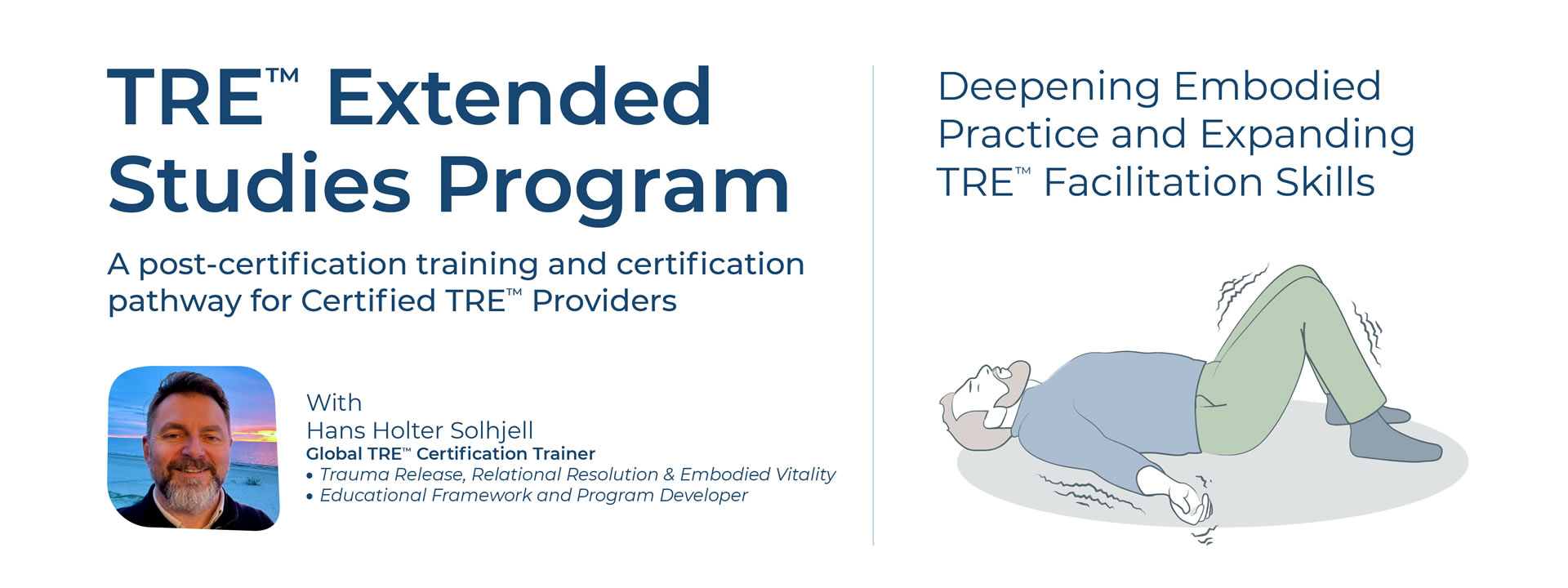
The TRE™
Extended Studies Program
Deepening Embodied Practice
and Expanding TRE™ Facilitation Skills
A post-certification training and certification pathway
for Certified TRE™ Providers
Leading to the title
Certified Autonomic Flow Facilitator™
Written by Hans Holter Solhjell
TRE™ Global Certification Trainer
TRE™ Extended Studies Lead Trainer
Program Developer and Educational Director
The TRE™ Extended Studies Program is a structured post-certification pathway for Certified TRE Providers who want to deepen and broaden their personal TRE practice, develop a wider and deeper range of facilitation skills, and support a wider range of tremoring, autonomous movement, and developmental processes over time.
The program builds on the foundation of the TRE Provider Certification Training and provides a structured framework for continued learning, professional development, mentoring, applied practice, and certification.
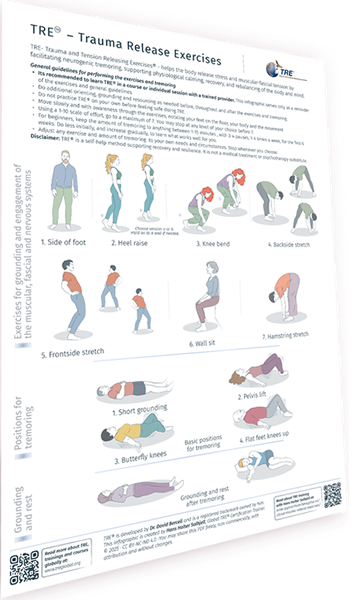
Get your free TRE™
exercises overview!
Add your email to the box below, and we will send you the PDF right away.
The program consists of two main modules, A and B. These modules are each designed to be completed over approximately six months per module. Participants then complete the personal practice, applied work, video requirements, and other certification requirements for the Autonomic Flow Facilitator Certification at the pace appropriate for their own professional practice and life circumstances. Completion leads to certification as a Certified Autonomic Flow Facilitator™.
The training combines recorded courses with live integration sessions, mentoring and practice groups, individual guidance, applied work with individuals or groups, reflective documentation, video-based learning and feedback, and a final certification review.
Explore TRE Extended Studies A + B
On the detailed A+B page you can find information about all practical aspects of the modules, work requirements etc.
Why a structured post-certification program?
The foundational TRE Provider Training provides an essential introduction to the TRE exercises, neurogenic tremoring, grounding, self-regulation, safe facilitation, and work with individuals and groups.
After certification, many providers want to continue developing their personal TRE process and facilitation skills. They may want more structured mentoring, feedback, practical application, and opportunities to explore how TRE processes can develop beyond the basic exercise sequence and the most commonly used tremoring positions.
The TRE Extended Studies Program provides a clear and flexible framework for this continued development, with defined training content, competency and practice requirements, mentoring, feedback, and certification. This gives providers transparency and predictability regarding what the pathway involves, what competencies they are developing, and how their continued professional development is recognised.
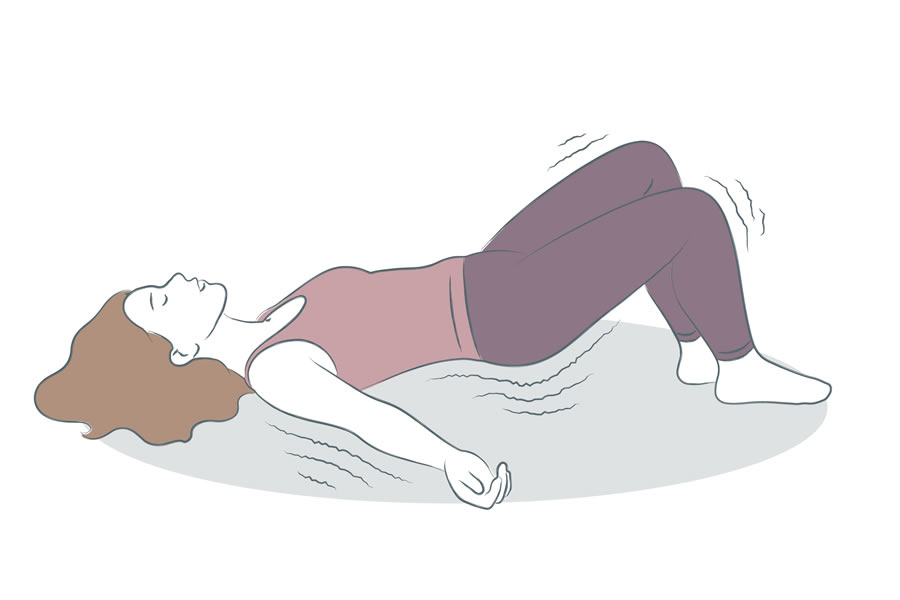
The program is organised into a series of smaller modules that gradually broaden the provider’s embodied practice, facilitation repertoire, and understanding of tremoring, autonomous movement, and release. This structure, with smaller modules, intends to make the training possible to integrate with professional work and other life commitments.
Who is the TRE Extended Studies Program for?
The TRE Extended Studies Program is for Certified TRE Providers who already have some experience with teaching TRE. It is particularly suited to providers who want to learn more about how the process of tremoring and release can develop over time, both in their own personal process, as well as in how they teach and facilitate sessions. And in particular are interested in learning to follow the body more closely, becoming more responsive to individual differences and developmental pathways rather than relying mainly on a standard session structure.
It is also suited to providers who are looking for a structured pathway toward further certification, with a clear curriculum, defined competencies, mentoring, and work requirements, rather than a series of disconnected courses or shorter sessions.
The program is also well suited to providers who value a combination of personal practice and reflective learning, and who want to develop through mentoring, observation, feedback, and applied work with individuals or groups. You do not need to work in any particular professional setting, but you should have an active interest in continuing to develop your own TRE process as well as your facilitation skills.
It is possible to participate in individual modules without completing the full certification pathway.
TRE Extended Studies A and B
Completion of the first two parts, TRE Extended Studies A and TRE Extended Studies B, together with the required personal practice, applied provider work, mentoring, video-based learning, individual guidance, and final review, leads to the title Certified Autonomic Flow Facilitator.
TRE Extended Studies A
TRE Extended Studies A focuses primarily on how tremoring can be facilitated and supported in a broader range of positions, in order to better follow the natural flow of the body’s movement and choose positions that support the unfolding autonomic tremor and movement process. Positions explored in this part include standing, sitting, and side lying on the floor, as well as transitions between positions.
Developing a broader repertoire of positions in which to tremor and facilitate tremoring allows for a more flexible, body-led approach to facilitation. It supports the ability to follow the body more fluently, recognise the movements the body is indicating or attempting to make, support movement flows and transitions, and understand how different positions can either facilitate or limit these processes.
TRE Extended Studies B
TRE Extended Studies B continues this development by focusing more specifically on including more areas of the body in tremoring, movement, and release. This includes further work with the upper body, hands and feet, as well as the head, including the face, jaw, eyes, mouth, nose, throat, and related areas.
Together, A and B are intended to help providers develop a broader and more autonomous embodied personal TRE practice, greater sensitivity to the body’s autonomic tremor and movement flows, and a wider and more flexible range of facilitation skills.
In the TRE Extended Studies Program, autonomic refers to non-voluntary physiological processes such as neurogenic tremoring, spontaneous movement, changes in breathing, and other forms of release. Autonomous refers to the participant’s self-direction, choice, boundaries, and internal authority. The training seeks both to support autonomic processes and to facilitate them in a way that strengthens personal autonomy.
Trainer and Mentor Development
Opportunities to develop as a TRE Extended Studies Trainer or Mentor are also available by application or request after certification as a Autonomic Flow Facilitator. This pathway is intended for experienced TRE Providers with strong teaching and facilitation skills, and may be particularly relevant for those who want to support participants locally, work in other languages, or already have an established network of interested providers.
Trainer and Mentor roles require well-developed communication, cooperation, and conflict resolution skills, as well as the ability to work independently as well as part of a team, and substantial TRE teaching experience. Experience organizing and marketing TRE, as well as an established TRE community network, is also a plus.
”I had been working with TRE for a couple years. I had done sessions with facilitators. I was stuck with the same type of tremors, same blocks and pain for almost a year.
After just one session with Hans, I had completely transformed. He is extremely experienced and creates a safe space for big releases. His expertise in trauma therapy and Somatic Experiencing helped me stay grounded and to be able to deal with painful memories during TRE releases.
If you need a next level TRE facilitator, look no further. He will get you on your journey to deeper releases.
Thanks again Hans. I will never forget how you helped me.”
How the program is structured
The TRE Extended Studies Program combines scheduled coursework with practice and certification requirements that can be completed more flexibly over time.
The coursework for TRE Extended Studies A and B includes recorded courses, live integration sessions, and mentoring and practice groups. Each module is designed to be comfortably completed within approximately six months, and A and B can therefore be completed within approximately one year.
Alongside and after the coursework, participants complete the personal practice, applied work with individuals or groups, individual guidance, video-based learning, reflective documentation, and final certification review required for the Certified Autonomic Flow Facilitator qualification.
These work requirements do not need to be completed within the same six-month course periods. They can be completed at a pace that fits the participant’s professional opportunities, experience, learning process, and life circumstances.
This structure is intended to provide both continuity and progression in the training, while allowing the practical and certification requirements to be adapted to individual circumstances.
Explore TRE Extended Studies A + B
On the detailed A+B page you can find information about all practical aspects of the modules, work requirements etc.
